
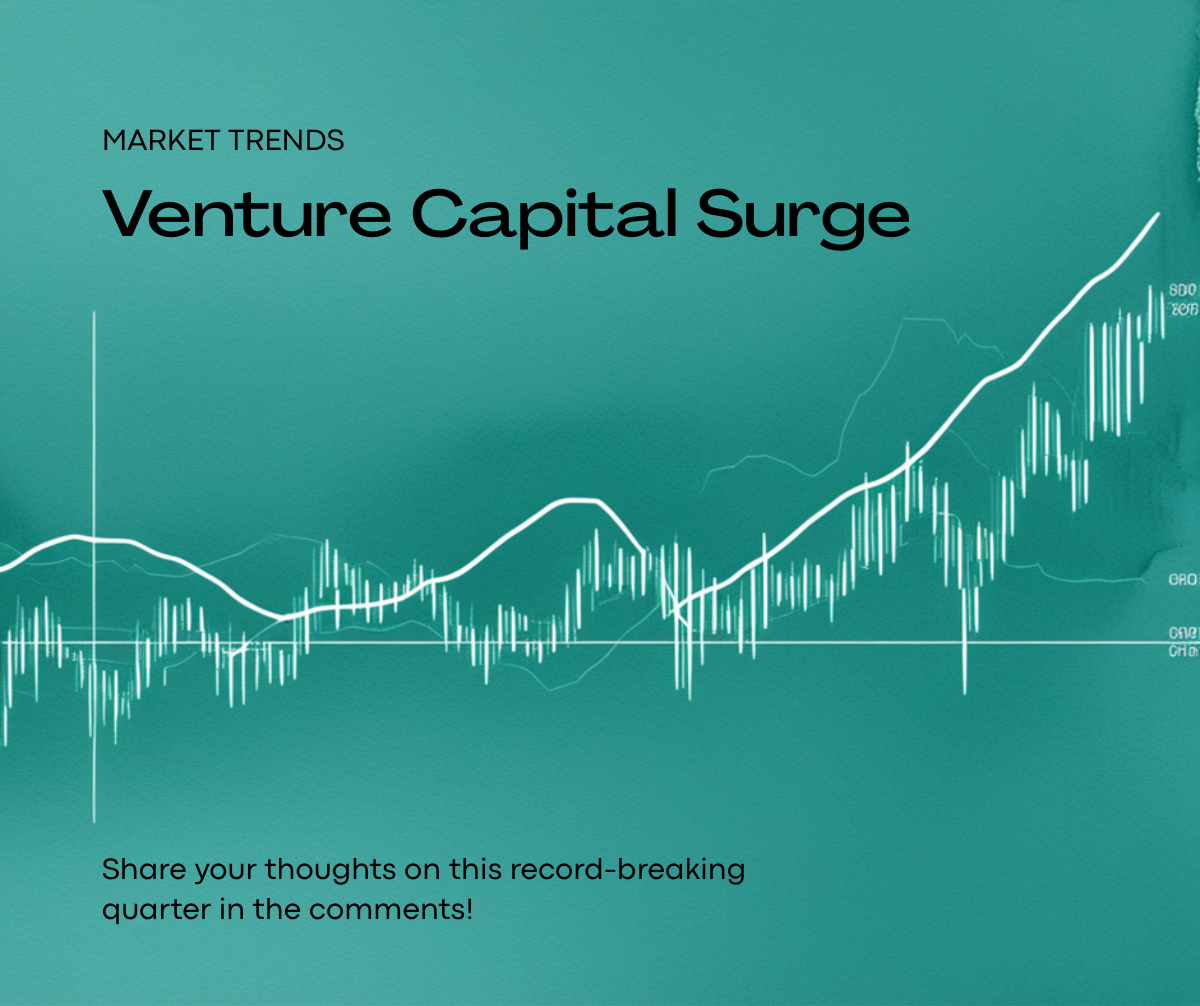
- Global VC investment hit $297 billion in Q1 2026 — a new all-time quarterly record — with AI accounting for 81% of the total.
- Four companies (OpenAI, Anthropic, xAI, Waymo) captured 64% of all capital raised; strip those out and the broader startup market tells a far more subdued story.
- OpenAI’s $122 billion raise was funded largely by sovereign wealth funds and tech giants treating AI infrastructure as a strategic asset class — not traditional venture capital.
Key Claim: Four companies captured 64% of all venture capital deployed in Q1 2026.
The headline number from Q1 2026 venture data is genuinely historic. Investors poured $297 billion into startups globally in Q1 2026 — a new all-time quarterly record. AI accounted for $239 billion of that total, or 81% of global venture investment.
The NextWave Signal — Sharp analysis, twice a week.
The number that better describes what actually happened: four companies raised $186 billion between them, representing 64% of all global venture capital in the quarter. OpenAI closed approximately $122 billion in what became the largest private funding round in history. Anthropic raised $30 billion. xAI secured $20 billion in Series E. Waymo closed $16 billion. Strip those four transactions out, and the remaining $111 billion distributed across thousands of other startups globally tells a different, more textured story.
The Mega-Round Anatomy
OpenAI’s raise — which came in two tranches with a combined valuation of $730 billion — was funded not by traditional venture capital but by a different class of capital entirely. Amazon invested $50 billion, NVIDIA $30 billion, and SoftBank $30 billion, with the remainder coming from sovereign wealth funds and institutional allocators. This is not a Series B growth round; it is infrastructure-scale capital deployment from organisations treating frontier AI as a strategic asset class comparable to energy or telecommunications.
The framing from institutional allocators reflects a straightforward thesis: frontier AI capability requires unprecedented compute investment, and the organisations best positioned to deploy and monetise that compute — and to control the access layer for the AI economy — are worth funding at sovereign scale. Whether the thesis proves out at $730 billion valuations is a separate question from whether the capital is real and the deployment is committed. It is both.
What It Means for the Rest of the Market
Venture capital as a category recorded its best quarter. But for most founders and investors, the picture in Q1 2026 was bifurcated in ways that the aggregate number obscures.
Funding to non-AI startups actually declined approximately 10% year-on-year in Q1. The concentration of capital at the absolute frontier pulls investor attention, partnership bandwidth, and LP appetite toward a small number of names. A partner spending their time managing a position in OpenAI is not spending that time evaluating a Series A in quantum sensing or advanced materials.
Outside the mega-rounds, the most active areas for emerging tech venture funding in Q1 2026 were physical AI and robotics — reflecting the convergence of falling sensor and battery costs with improved foundation model capabilities — and AI-biotech, where companies like Isomorphic Labs are building what they call “AI Science Factories” that combine specialised models with automated lab robotics. These categories attracted meaningful capital, but in the single-digit billions range, not the double-digit billions that characterise the frontier lab rounds.
Deep tech’s share of global venture and private equity has doubled over the past decade, from roughly 10% in 2014 to over 20% entering 2026. But “deep tech” in 2026 increasingly means AI-adjacent hardware and AI-enabled science rather than pure-play hardware bets. The sectors that moved capital in Q1 — physical AI, robotics, AI-accelerated drug discovery — all have AI at the centre of the investment thesis.
The Concentration Question
The degree of concentration in Q1 2026 is not simply a reflection of large rounds being available. It reflects a structural shift in who is doing the investing. As Global Venturing noted, corporate venture capital has grown proportionally larger than ever in these mega-rounds. Amazon, NVIDIA, Microsoft, and SoftBank are not diversified venture funds optimising for portfolio construction. They are strategic investors with direct commercial relationships with the companies they are funding — and with incentives to ensure those companies remain competitive and dependent on their infrastructure.
This creates a dynamic where the frontier AI layer is increasingly funded by the infrastructure layer that the frontier AI layer depends on. Whether that is stable over a multi-year horizon — given the antitrust scrutiny it invites — is one of the more consequential open questions in the tech economy.
What to Watch in Q2 and Beyond
The signals worth tracking as the year progresses are the IPO pipeline (OpenAI has indicated readiness to go public when market conditions allow, which would represent the largest tech IPO since at least the NVIDIA era), the pace of Series A and B activity outside AI as a proxy for whether non-AI deep tech is being starved of capital or simply waiting, and whether the physical AI and robotics category builds momentum into a breakout category in its own right or remains a secondary beneficiary of the AI funding wave.
The record is real. The distribution behind it is what matters for understanding where the technology economy is actually going.
This article was produced with AI assistance and reviewed by the editorial team.
Further Reading
- The AI Chip Shortage Never Ended. It Just Changed Shape.
- Open Source AI Has Closed the Performance Gap. Now the Real Choice Begins.
Source Trail
- PitchBook Venture Monitor — Quarterly global VC deal and dollar volume data
- Crunchbase News — Venture — Funding round tracking and startup investment analysis
- CB Insights State of Venture — Market intelligence on VC trends and mega-round concentration
- OpenAI funding announcement — Primary source on OpenAI’s Q1 2026 capital raise structure
Related posts:
 The AI Chip Shortage Never Ended. It Just Changed Shape.
 The Five AI Shifts That Actually Mattered in 2025
 The Definitional Gap: Why the Industry Can’t Agree on What “Production” Means for AI Agents
 Silicon Quantum Computing Just Proved It Can Do Real Computation — and Existing Chip Fabs Could Build It
