
Silicon quantum computing just cleared its most important technical hurdle.
Researchers at the Shenzhen International Quantum Academy (SZIQA) have demonstrated the first universal set of logical quantum operations on a silicon-based processor, closing the last major capability gap between silicon qubits and their superconducting and trapped-ion rivals.
The result, published in Nature Nanotechnology on 23 March 2026, matters less for what it computes — a water molecule’s ground-state energy — than for what it implies: the only quantum platform compatible with existing semiconductor manufacturing has now proved it can perform arbitrary fault-tolerant computation.
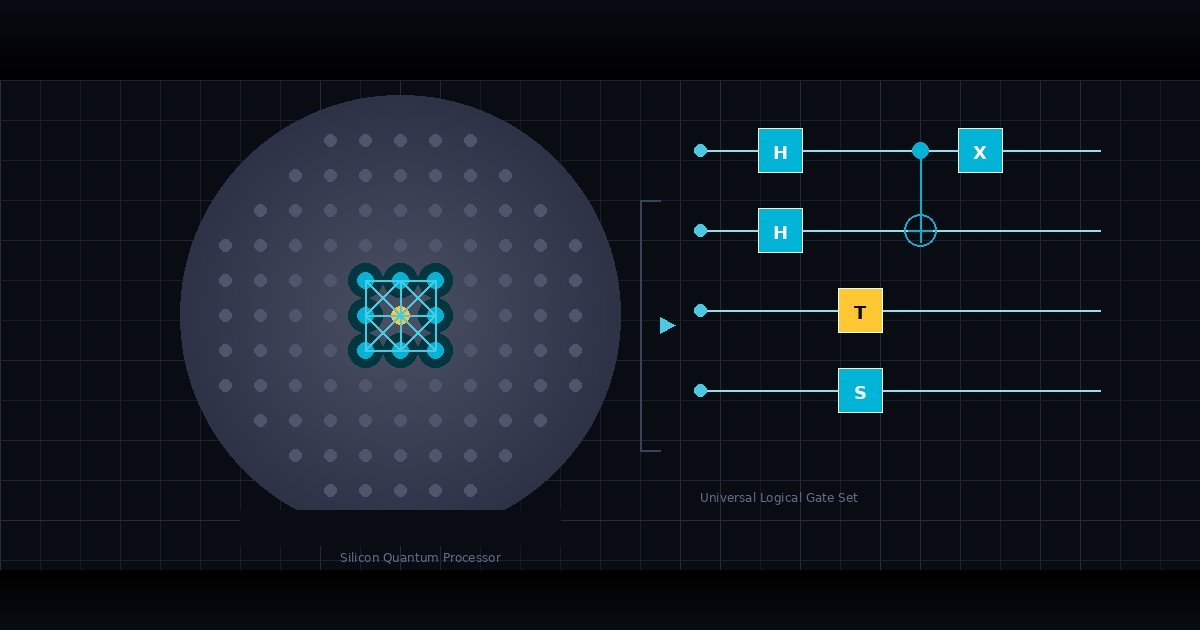
Key Technical Milestone
99.9% Two-Qubit Logical Gate Fidelity
SZIQA silicon quantum computing logical qubits demonstrate the fault-tolerance threshold necessary for commercial semiconductor fab integration in 2026.
The progress in silicon quantum computing is part of a wider race to show that quantum hardware can do useful work. For the competing approach from the large platform vendors, see our coverage of IBM’s quantum advantage push.
For an industry that has poured billions into quantum hardware without a clear path to mass production, that distinction changes the calculus.
What the SZIQA Team Actually Built
The processor uses five phosphorus donor nuclear spins embedded in an isotopically purified silicon-28 lattice, patterned with atomic precision via scanning tunnelling microscopy (STM) lithography. The team encoded four of these physical qubits into two logical qubits using the [[4,2,2]] quantum error-detecting code — a scheme that adds redundancy so the system can detect certain errors without destroying the data.
Any breakthrough in silicon quantum computing also raises the stakes for security planning, since capable machines would threaten today’s public-key encryption. Readers can follow that thread in our guide to post-quantum cryptography and the Shor RSA migration deadline.
On this encoded pair, they executed a universal logical gate set: single-qubit Clifford gates (X_L, S_L, H_L), a simultaneous Hadamard, a two-qubit CNOT_L, and — critically — the non-Clifford T_L gate, achieved through a gate-by-measurement technique using magic states. The T gate is what separates a limited quantum circuit from one capable of universal computation. Without it, a quantum processor can only run a restricted class of algorithms. With it, the machine can in principle execute any quantum algorithm.
Average physical gate fidelities exceeded 95%, and logical state fidelities matched that threshold after post-processing. Logical coherence times reached approximately 208 microseconds — long enough to run multiple error-correction cycles within the qubits’ operational window.
To demonstrate practical utility, the team ran a variational quantum eigensolver (VQE) algorithm on the two logical qubits to compute the ground-state energy of a water molecule (H₂O). The result approximated the theoretical value after basic error mitigation. It is a modest calculation by classical standards, but it represents the first time a silicon quantum device has executed a real algorithm on error-detected logical qubits.
Why Silicon Is the Only Platform That Scales Like Semiconductors Do
Quantum computing in 2026 is dominated by two hardware approaches. Superconducting qubits — the technology behind Google’s and IBM’s machines — operate fast (nanosecond gate times) but require specialised cryogenic fabrication, custom dilution refrigerators costing millions, and suffer from coherence times of roughly 30 microseconds. Trapped-ion systems, used by IonQ and Quantinuum, offer excellent stability (coherence times measured in seconds) but scale poorly because each ion needs individual laser control.
Neither platform can be manufactured in the factories that produce the world’s microprocessors.
Silicon spin qubits occupy a different position. They are fabricated on the same material — and potentially in the same facilities — that produce billions of classical chips annually.
A silicon qubit can be defined in a footprint as small as 100 × 100 nanometres, giving the platform the highest qubit density of any approach. Recent industrial demonstrations have pushed single-qubit fidelities beyond 99.9% uniformly across 300 mm CMOS wafers. In November 2025, Australia’s Silicon Quantum Computing (SQC) demonstrated patterning 250,000 qubit registers in just eight hours on standard wafers.
The bottleneck was never fabrication. It was computation. Until the SZIQA result, silicon quantum computing had not demonstrated the full universal logical gate set — including the T gate — with error detection. Superconducting and trapped-ion systems had cleared this bar. Silicon had not. That asymmetry made it difficult to argue that silicon’s manufacturing advantage mattered when the platform could not yet do what quantum computers need to do.
That argument no longer holds.
A Commercial Ecosystem Is Forming
The SZIQA result does not exist in isolation. A cluster of investment and product developments in the past four months signals that industry is taking silicon quantum computing seriously as a commercial path.
In January 2026, Dublin-based Equal1 raised $60 million to scale its Bell-1 quantum server — a rack-mounted unit built with standard CMOS manufacturing that requires no dilution refrigerators. Equal1 is already shipping units to the European Space Agency’s Space HPC Centre in Italy. The company’s roadmap targets millions of physical qubits and thousands of logical qubits by 2030, relying entirely on semiconductor economics: costs that fall with volume and yields that improve with iteration.
On 24 March — one day after the SZIQA paper appeared — Australia’s National Reconstruction Fund Corporation invested $20 million in Silicon Quantum Computing to accelerate atomic-scale quantum chip production. SQC’s approach also uses phosphorus atoms in silicon, the same physical substrate as the SZIQA experiment.
Intel has been building 48-dot quantum array test chips on 300 mm wafers through its fabrication facilities. SEALSQ, a Franco-Swiss semiconductor firm, unveiled a 2026–2030 strategic plan explicitly targeting CMOS-compatible silicon quantum computing. Belgium’s imec, the world’s leading semiconductor research centre, is developing physical qubit platforms on standard silicon substrates.
None of these efforts depended on the SZIQA result. But the result gives each of them a stronger technical foundation. The argument for silicon quantum computing previously required a caveat: “it should work, but universal logical operations haven’t been demonstrated yet.” That caveat is now gone.
The Geopolitical Dimension
The global distribution of silicon quantum activity is worth noting. The SZIQA breakthrough is Chinese. SQC is Australian. Equal1 is Irish. QpiAI — which announced a 40x speedup in quantum error correction on its 64-qubit Kaveri processor on 25 March — is Indian. Intel is American, but its quantum programme is smaller than its superconducting competitors Google and IBM.
The United States’ dominant quantum efforts — Google’s Willow processor, IBM’s Heron — are built on superconducting architectures. If silicon quantum computing emerges as the scalable path to fault tolerance, the countries and companies that invested early may hold a structural advantage.
This does not mean superconducting qubits are obsolete. They remain faster for near-term noisy intermediate-scale quantum (NISQ) applications. But the history of computing suggests that the platform that aligns with industrial manufacturing wins at scale. Transistors replaced vacuum tubes not because they were faster — early transistors were slower — but because they could be mass-produced on silicon wafers.
Foundry Integration and Commercial Milestones for Silicon Quantum Computing
Demonstrating two-qubit logic gates on 300mm silicon marks an inflection point where silicon quantum computing ceases to be an academic physics experiment. By leveraging existing CMOS lithography and planar transistor manufacturing lines at major commercial foundries, silicon quantum computing sidesteps the bespoke fabrication bottlenecks that constrain superconducting and trapped-ion architectures.
Yet bridging the gap to utility-scale computation demands solving cryogenic thermal dissipation and co-packaged control interconnects. Commercial roadmaps for silicon quantum computing depend on achieving fault-tolerant gate fidelities above 99.9% while keeping dilution refrigerators under milliwatt thermal loads. As pilot lines mature, silicon quantum computing will face its definitive commercial test in delivering repeatable yield across full wafer diameters.
What to Watch
Foundry engagement. No major foundry — TSMC, Samsung, Intel Foundry Services — has publicly announced a silicon qubit fabrication partnership. The gap between STM lithography (used by SZIQA) and standard CMOS lithography is a real constraint. If a foundry announces a silicon qubit programme in the next 12 months, it signals the industry sees a manufacturing path.
Error correction overhead. The 208 μs logical coherence time is sufficient for basic demonstrations, but practical fault-tolerant algorithms will need either longer coherence or faster error correction cycles. Watch for follow-up results combining the SZIQA logical operations with hardware-accelerated error correction — the kind QpiAI is developing.
Qubit count scaling. The SZIQA device uses five physical qubits. Commercial fault-tolerant quantum computing likely requires millions. SQC’s 250,000-register patterning demonstration is promising, but the distance between patterning qubit registers and running logical operations on them remains large.
Policy and funding signals. Australia’s $20 million investment in SQC and India’s National Quantum Mission backing of QpiAI suggest governments are diversifying their quantum bets toward silicon. Whether the US and EU follow — or double down on superconducting — will shape the competitive landscape for the next decade.
This article was produced with AI assistance and reviewed by the editorial team.

9 thoughts on “Silicon Quantum Computing Just Proved It Can Do Real Computation — and Existing Chip Fabs Could Build It”