TSMC Q1 2026 Earnings — What 66% Gross Margins Signal About AI Infrastructure

TSMC Q1 2026 margins analysis chart

The TSMC Q1 2026 margins story starts with the top line: TSMC reported Q1 2026 revenue of $35.9 billion — up 40.6% year-over-year and 6.4% sequentially — with net income of $18 billion, a 58% increase that marks the eighth consecutive quarter of double-digit profit growth. The headline numbers are notable. What they obscure is … Read more

The Grid Cannot Keep Up: How AI’s Power Demand Is Forcing Hyperscalers to Buy the Infrastructure Themselves

AI power demand grid load growth and hyperscaler data center energy requirements for 2026

The AI power demand grid problem became concrete in northern Virginia in July 2024, when a voltage fluctuation triggered the simultaneous disconnection of 60 data centers. The resulting 1,500 MW power surplus required emergency grid adjustments to prevent cascading outages across the PJM Interconnection — the largest grid operator in the United States. The incident … Read more

Post-Quantum Migration Has a Deadline: What Qrisp 0.8 Changes

Post-quantum cryptography migration timeline and Shor algorithm quantum circuit depth benchmarks

The clock on post-quantum cryptography migration is set by hardware timelines as much as by standards bodies. Progress in silicon quantum computing and logical operations determines how soon attackers could threaten today’s encryption. Quantum capability is advancing on several fronts. The IBM quantum advantage roadmap is one signal that the threat window is narrowing, which … Read more

The Packaging Bottleneck: Why TSMC’s CoWoS Lines — Not Its Fabs — Now Control AI Chip Supply

TSMC packaging bottleneck and CoWoS advanced packaging capacity constraints for AI accelerators

Demand for leading-edge accelerators keeps the pressure on. The Nvidia Rubin GPU production and silicon outlook shows how much capacity hyperscalers are counting on, which is why any TSMC packaging bottleneck delay ripples through the roadmap. Capacity planners should track the TSMC packaging bottleneck alongside wafer output, since either one can set the pace of … Read more

RISC-V AI Accelerators in 2026: Proven Silicon Architecture and Automotive Adoption

RISC-V AI accelerators and automotive silicon adoption share in 2026

RISC-V has crossed a meaningful threshold. More than 13 billion cores built on the open instruction set architecture (ISA) have shipped to date, server-grade silicon from Alibaba and Ventana entered production in 2025, and automotive chip giants Bosch, Infineon, NXP, and Qualcomm have formally committed to standardising on it. Yet Arm still powers more than … Read more

Optical Interconnects and the AI Data Center Bandwidth Wall

Optical interconnects AI data center bandwidth architecture and packaging roadmap

The race to build larger AI clusters has pushed GPU counts into the hundreds of thousands. Raw compute has scaled remarkably — NVIDIA’s Hopper and Blackwell generations ship in volume, Google has iterated through multiple TPU generations, and Meta and Microsoft have deployed custom ASICs. As compute supply has grown, a different bottleneck has emerged … Read more

HBM’s Thermal Wall: Why One Korean Chipmaker Controls the Pace of the AI Build-Out

HBM memory bottleneck and high-bandwidth packaging supplier market share chart for 2026

The HBM memory bottleneck is the constraint that sets how fast AI hardware can ship. Every NVIDIA Blackwell B200 GPU ships with 192 gigabytes of HBM3e memory spread across eight stacks, delivering 8.0 terabytes per second of memory bandwidth. That is 2.4 times the memory capacity of an H100 — packed into roughly the same … Read more

Silicon Quantum Computing Just Proved It Can Do Real Computation — and Existing Chip Fabs Could Build It

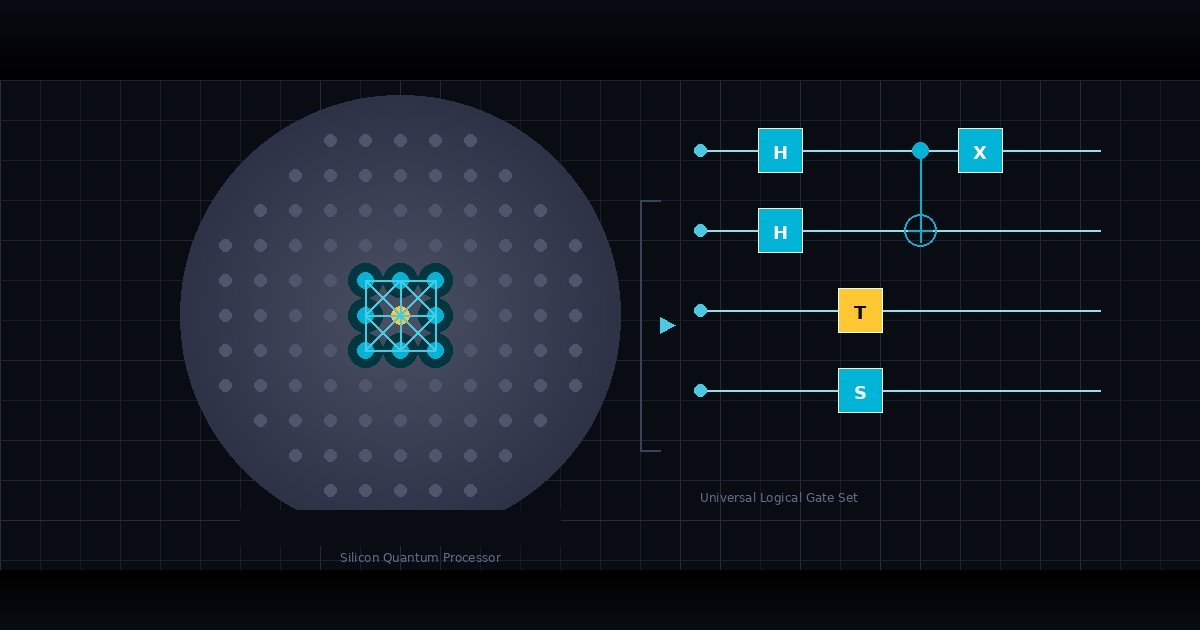
Silicon quantum computing chip architecture and logical qubit demonstration in 2026

Silicon quantum computing just cleared its most important technical hurdle. Researchers at the Shenzhen International Quantum Academy (SZIQA) have demonstrated the first universal set of logical quantum operations on a silicon-based processor, closing the last major capability gap between silicon qubits and their superconducting and trapped-ion rivals. The result, published in Nature Nanotechnology on 23 … Read more